VORRINGARD · Journal · Boule, Bâtard, Baguette
Boule, Bâtard, Baguette
Shape changes how far heat travels and how much crust you get per pound of crumb. Which pot suits which loaf, what goes wrong in the wrong one, and what to buy in what order.
Shape Is Function
A loaf bakes from the outside in as heat moves through the cast iron and crosses the narrow gap between the hot wall and the dough's surface before traveling toward the center of the mass, and the distance matters. In a round vessel, the center is never more than half the diameter away from the metal, while in a long narrow shape, the ends sit close to the iron but the middle rests farther back. If the pot does not match the shape, the heat arrives unevenly, so some parts of the crumb set before others, leaving you with a doughy middle and a burnt end.
Crust is surface area exposed to dry heat, and a baguette carries more of it per pound of crumb than a boule, while the round loaf is economical because it feeds more people with less exterior. The oblong bâtard sits between the two. Your choice of vessel controls how that crust forms because tight walls hold steam close to the surface for the first twenty minutes, and that steam keeps the crust elastic so the loaf can expand. The right fit means the walls are close enough to create that microclimate but far enough away that the dough does not touch them while it springs. Touching kills the spring.
We make twenty-two designs because bakers bake different shapes, and the measurements decide which one you want. A 4.5 quart round measures 12.7 inches across, while a 5 quart loaf oven runs 14.2 inches long with handles and 11.7 inches without. The 7 quart loaf oven stretches to 15.7 inches, and the baguette tray spans 17 inches. These numbers determine what you can proof and how the heat reaches the crumb. The weight of the iron matters too because a 4.5 quart pot weighs 10.87 pounds, and a 6 quart weighs 12.94 pounds. That mass stores heat, so when you open the oven door, the iron keeps its temperature steady. Your dough does not stall.
The Boule and the Round Pot
The boule is the round country loaf that spreads outward in a circle and rises more than it spreads. You need a pot with walls tall enough to contain that rise without the dome pressing against the lid or the sides.
Our 4.5 quart round stands 7 inches tall, while the 6 quart round reaches 7.7 inches, and the walls are vertical. When you lower the dough on its parchment sling or silicone sling, it sits in the center with air space all around. That space fills with steam as the loaf exudes moisture in the first ten minutes of the bake, so the steam softens the crust, and the loaf can expand upward. If the walls were low, the dome would burst outward into a muffin top or press flat against the lid and tear.
The 4.5 quart vessel suits a dough meant to feed two to four people, while the 6 quart round suits four to six. The wide 6 quart at 14.4 inches across and 7.4 inches tall gives you a broader base, and it weighs 11.57 pounds. A wetter dough spreads into a flatter disk before it springs, so the wider pot leaves room for that spread without the loaf touching the sides. A boule that touches the wall early forms a hard seam and stops expanding. You want the loaf to rise freely until the crust sets at 500°F.
The weight of these pots matters when you lift them because the 4.5 quart weighs 10.87 pounds, and the 6 quart weighs 12.94 pounds. You will lift the pot from the counter to the oven then later remove the lid with one hand while the other stays gloved. The mass is part of the tool, because it holds the heat steady when your oven cycles, and the enamel over it needs no seasoning at all. Hand washing with warm water is what we recommend.
The Bâtard and the Oblong Oven
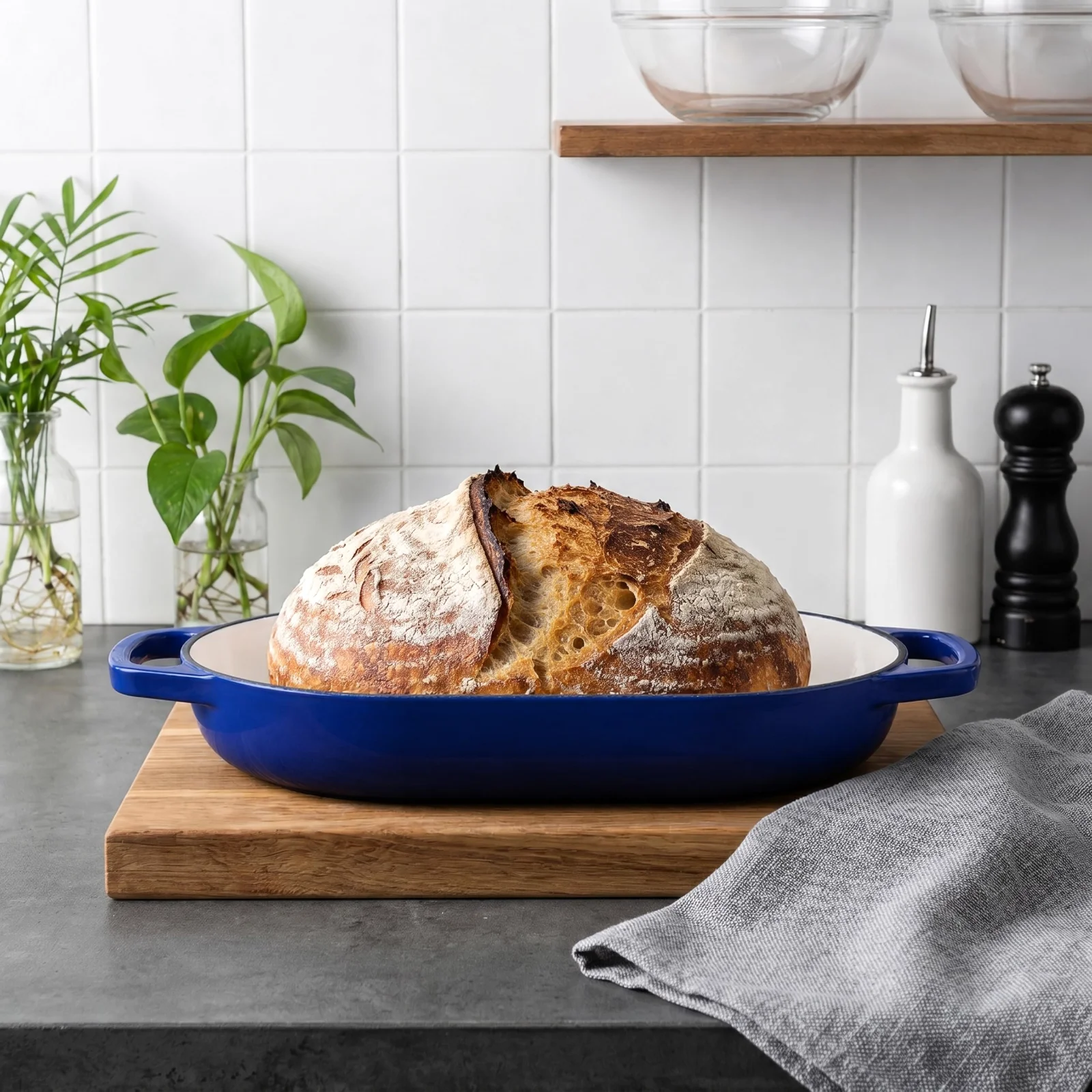
A bâtard is an oblong loaf shorter than a baguette and thicker in the middle that looks like a football. If you place this shape in a round pot, the ends sit far from the walls while the sides crowd close, so the crust sets unevenly. The sides harden before the ends color, and steam pools in the corners instead of hugging the loaf. The result is a loaf that looks baked but has a damp line through the middle.
An oblong oven solves this because the walls run parallel to the loaf. Heat reaches the center from the long sides at the same rate it reaches the ends, so the steam stays evenly distributed.
Our loaf ovens come in two lengths, and the shorter one measures 14.2 inches long with handles, 11.7 inches without, standing 5.4 inches tall, which suits a dough scaled for two to three people. The 7 quart runs 15.7 inches long and 5.9 inches tall sized for four to six servings. The 5 quart weighs 11.0 pounds, and the 7 quart weighs 14.20 pounds. The extra length in the 7 quart gives you room for a longer proofed loaf without the ends touching the metal. When the dough touches, it stops expanding there, so the loaf becomes rectangular with rounded ends instead of a smooth oval.
The 4 quart oval offers a middle path because it measures 13.5 inches with handles and 11 inches without, and it suits two to three servings. The walls are lower than the round pots at only 5.4 inches tall, but the length gives a bâtard room to lie flat without curling. The 4 quart oval weighs 11.7 pounds and works on gas, electric, ceramic and induction, as do all our vessels. It is not for microwaves.
When you shape a bâtard, you create surface tension along the long axis then place it seam side up in the proofing basket and flip it onto the counter. The oval or loaf oven receives it without you reforming the shape, so the dough stays relaxed. The even heat lets you score the top with confidence that the slash will open uniformly from end to end.
The Baguette Problem
The baguette is the hardest shape to bake in a home kitchen because it is long and thin with a high ratio of crust to crumb. It needs steam along its entire length for the first twenty minutes, so without steam the crust sets too early and the loaf bursts in random places or stays pale and soft. A standard sheet pan leaves the bottom sitting flat on metal while the steam washes away underneath, and the loaf dries out from the bottom up.
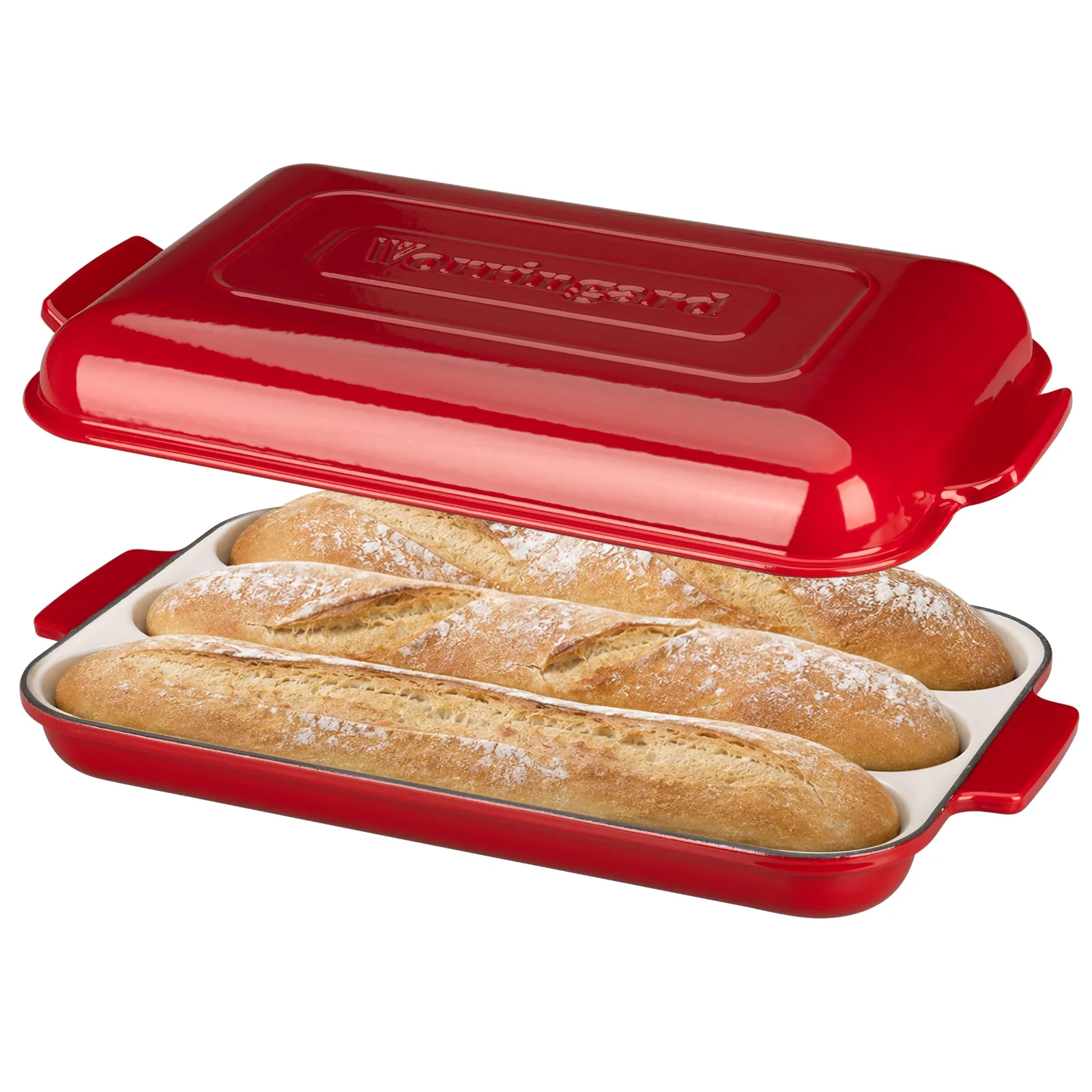
A channelled cast iron baker changes the physics because the floor is cast into long troughs, one for each loaf, so the dough lies in a cradle of hot iron rather than flat on a sheet. The lid closes over the whole tray, and the steam the three loaves give off stays with them instead of leaving through the vent. That is the part a sheet pan cannot do at all.
We make the baker in two sizes. The three-slot version measures 17 inches long with handles and 15 inches without, it is 9.8 inches wide, it weighs 17.3 pounds, and three standard baguettes fit inside with air between them. The five-slot version keeps the same footprint and divides the width into narrower channels, so the choice depends on your dough. Three channels let you bake thicker rustic sticks with room to widen, while five suit thinner ones that bake faster and crisp all round, and both fit the width of a standard home oven rack.
A baguette proofed in a folded cloth couche transfers best: roll it onto a peel or a stiff piece of cardboard, then shoot it into the hot channels in one motion. At 17.3 pounds of iron the tray does not shift when you land the dough, so preheat it empty until the metal is saturated at 500°F. The first blast of heat off 17.3 pounds of iron is what sets a baguette crust before the dough has time to slump.
Two Small Loaves vs. One Big One
Sometimes two small loaves serve you better than one large one because you might want one boule for dinner tonight and another for breakfast tomorrow. You might be testing two flours in one batch, or simply chasing the extra crust that two smaller rounds give you.
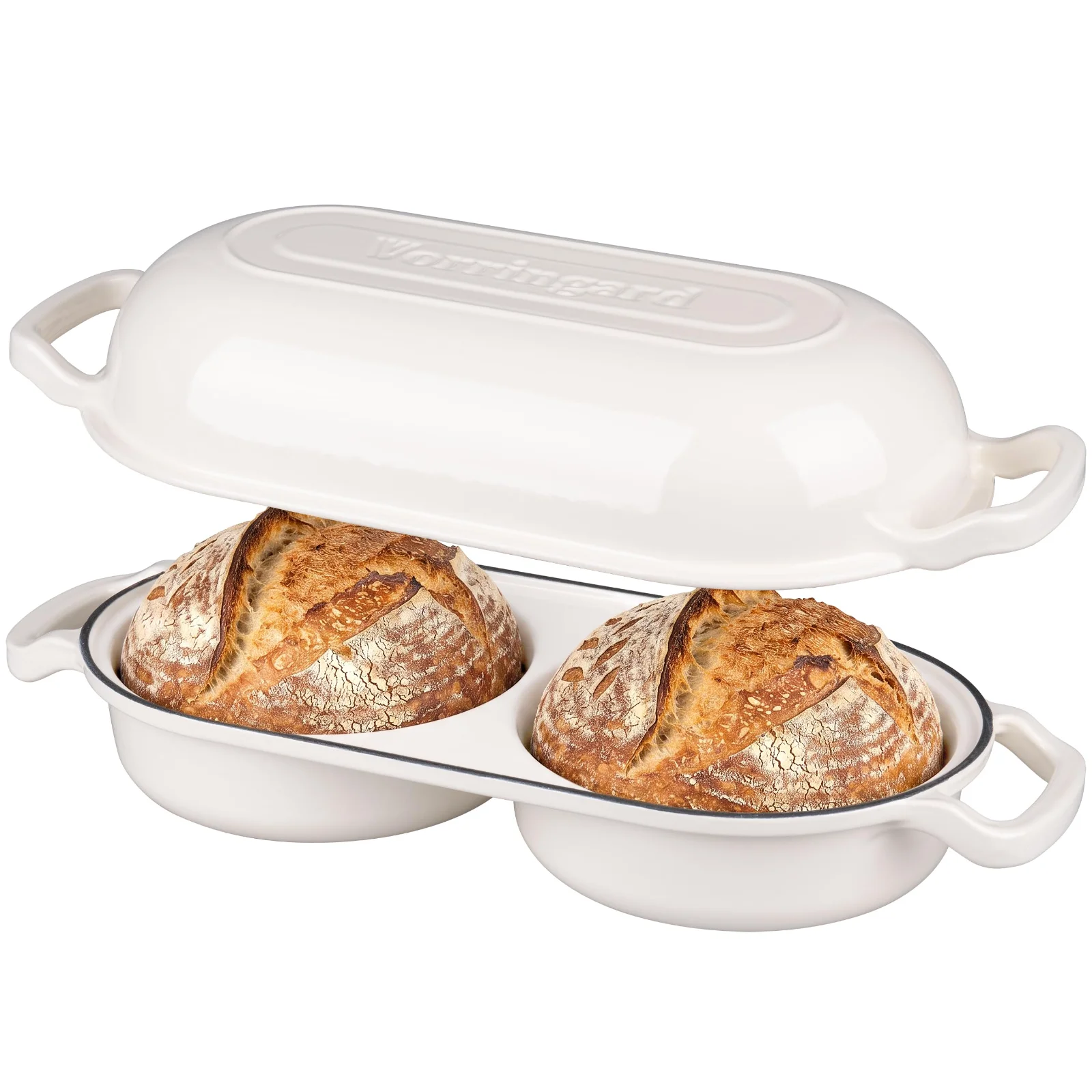
The double round loaf pan holds two separate wells because each well measures 6.3 inches across, while the full pan spans 16.3 inches wide and weighs 12.0 pounds. You shape two boules of roughly equal size then place one in each well. They rise upward not outward because the walls of each well sit close to the dough, and the separation keeps them from merging into one odd-shaped mass.
The advantage is control because two small loaves bake faster than one large one, so you can pull one out while the other continues to darken, or mix seeds into one and leave the other plain. The 6.3 inch diameter of each well matches the base circumference that a small boule naturally wants to spread to. The pan is 12.0 pounds of iron, enough to hold 500°F steady under two loaves without a temperature drop that would stunt their rise.
Matching the Basket to the Vessel
The proofing basket shapes the loaf before the oven does, which is why we pack one into our starter sets along with a cloth liner, a lame with spare blades, a dough scraper, a bench scraper, and a silicone sling. The basket is not a decoration because it is a mold that imprints texture and holds the shape during the final rise.
If you bake in a round pot, you proof in a round basket, so the dough relaxes into a sphere. When you turn it out, it sits high on the counter holding its tension. If you force that round dough into an oblong pot, the sides touch the walls immediately, so the crust sticks, the loaf cannot expand, and it bakes dense at the sides and airy in the middle.
Turning a proofed loaf out of a basket requires a decisive flip so the seam lands on the parchment without the dough collapsing sideways.
If you bake in an oval pot, you proof in an oval basket, so the bâtard shape holds its tension along the long axis. The oval basket has a spiral pattern from the cane that leaves a faint flourish on the finished loaf. When the basket shape matches the pot, the dough drops into place with an inch of clearance on all sides. That inch is your margin for error.
When the shapes mismatch, the dough spreads to fill the corners of the wrong container, so a round dough in an oval basket flattens into a disk with pointy ends, while an oval dough in a round basket crowds the ends and thins the middle. The resulting loaf bakes unevenly with dense patches where the dough compressed itself to fit. The 4.5 quart round at 12.7 inches across demands a round basket, while the 5 quart loaf oven at 14.2 inches long demands an oval. The 4 quart oval at 13.5 inches with handles also takes an oval basket but shorter than the one you would use for the 7 quart oven.
Choosing the Right Vessel
The following table matches four common loaf shapes to the vessels we make, with the servings each pot suits in the third column and the specific failure you get from the wrong pairing in the last.
| Loaf Shape | Vessel | Capacity | Result in Wrong Vessel |
|---|---|---|---|
| Round boule | 4.5 qt round | 2 to 4 servings | In an oblong oven, the round flattens and the ends dry out before the center bakes. |
| Large round | 6 qt round | 4 to 6 servings | In a 5 qt loaf oven, the dough crowds the long walls and splits at the seams. |
| Bâtard | 5 qt loaf oven | 2 to 3 servings | In a round pot, the sides harden fast while the pale ends stay undercooked. |
| Large bâtard | 7 qt loaf oven | 4 to 6 servings | In a 4 qt oval, the dough touches the lid and tears, releasing steam too early. |
| Baguette | 3-slot tray | 17.3 lb iron mass | On a flat sheet the steam escapes, the crust sets early and the loaf bursts. |
Timing and Shaping by Form
Proofing time varies with temperature and starter strength, but shaping targets are fixed by the dimensions of the vessel. The table below pairs each loaf shape with the proofing tool and the measurable target you aim for when shaping.
| Shape | Proofing Tool | Shaping Target |
|---|---|---|
| Boule | Round cane basket | A 7 to 8 inch round, so it clears the walls of the 4.5 qt pot. |
| Bâtard | Oval cane basket | A 10 inch length, inside the 11.7 inch floor of the 5 qt loaf oven. |
| Baguette | Linen couche | 15 inch length to fit the clear span of the 3-slot tray. |
| Twin boules | Two round baskets | Two 6.3 inch rounds to fill the double loaf pan wells. |
Hydration and Containment
Hydration is the percentage of water to flour in your dough, and a wet one spreads outward like a puddle before it bakes, so without walls to hold it, it becomes a flatbread. The vessel contains the spread because the wall height determines how much vertical spring you get before the crust sets at 500°F.
Our round pots stand 7 inches and 7.7 inches tall, while the loaf ovens are shorter at 5.4 inches and 5.9 inches, but their length guides the spread forward rather than outward. The baguette baker works the other way round because its channels are only as wide as a stick, so the dough cannot widen at all. The iron holds heat, so when the wet dough hits that temperature, the outside sets fast while the inside stays moist.
A 4.5 quart round with 7 inch walls can hold a dough that wants to spread to 10 inches across because the walls corral it and the lid traps the steam. The resulting loaf is taller than it would be on a stone. The 6 quart wide pot at 7.4 inches tall and 14.4 inches across handles even wetter doughs that would otherwise become pancakes. The 5 quart loaf oven at only 5.4 inches tall requires a stiffer dough or a tighter shape, so the loaf does not mushroom over the rim. Match the hydration to the wall height because high hydration needs high walls or narrow channels.
Building a Baker's Set
We make twenty-two designs across one hundred thirty-nine color and size combinations, priced from $25.99 to $89.99, with star ratings between 4.4 and 4.8 drawn from roughly three thousand two hundred ratings since the first pots went on sale in 2024. You do not need to buy them all. Two vessels are enough to start with, and perhaps a third later.
Start with the 4.5 quart round because it bakes boules for two to four people, and it weighs 10.87 pounds while it measures 12.7 inches across. It fits in any oven, so learn how it holds heat and how long it takes to preheat to 500°F.
Add the 5 quart loaf oven second: at 14.2 inches long and 11.0 pounds, it takes bâtards and sandwich loaves. It suits two to three servings, so now you can bake a round loaf on Saturday and a long one on Sunday, which covers the two basic shapes that feed most households.
If you bake baguettes often, add the three-slot tray because it weighs 17.3 pounds, spans 17 inches, and is a specialized tool for one specific shape. If you bake multiple small loaves for gifts, choose the double round loaf pan with its two 6.3 inch wells and 16.3 inch total width.
The enamel colors range from white to latte to sea salt to sage green, green, dark green, blue, bluegreen, red, pink, purple and yellow, while the bare seasoned iron is black. All of them are oven safe to 500°F, and hand washing with warm water is what we recommend for every one.
Buy for the loaf you actually bake, not the loaf you imagine baking. One round pot and one oblong oven will teach you more than a cabinet full of mismatched pans. Match the vessel to the dough.
More from the journal
Every pot named on this page sits on one page in VORRINGARD bread ovens, with its capacity, its weight and its colours.